How a cap table simplification vehicle actually works

Too many investors on your cap table? You’re not alone.
As companies grow and raise capital from multiple angels, syndicates, and funds, the administrative burden of managing a lengthy cap table can create unnecessary overhead, slowing decision-making and complicating future fundraising rounds.
That’s where a cap table simplification vehicle comes in.
What is a “cap table simplification vehicle”?
A cap table simplification vehicle (often set up as a special purpose vehicle, or SPV) is a legal entity that consolidates the securities (usually equity or SAFEs) previously held by multiple stakeholders into a single line on your cap table.
Those stakeholders swap their holdings in the company for interests in the vehicle, while keeping their economic exposure in the underlying company. The result? Streamlined governance and cleaner operations without sacrificing your stakeholders’ return potential.
In practice, this is the same way deal leads use SPVs to bundle many investors into one entity on a cap table (as sometimes referred to as syndication vehicles, or co-investment vehicles).
Why simple cap tables are important
A simple cap table improves:
- Decision-making speed for daily matters: Fewer stakeholders mean fewer signatures, allowing the team to make decisions faster. Consolidating investors into one vehicle lets the lead handle routine approvals while economic or commercial considerations still get investor votes.
- Governance clarity: Approvals are easier when gathered from one vehicle lead. Reserved matters commonly cover capital structure changes, M&A, large asset sales, and distribution policy changes.
- Operational hygiene: Reduces data errors, makes valuation and audit support simpler, and streamlines onboarding into equity admin systems (transfer restrictions, ROFR, notice tracking).
- Future financing readiness: A clean cap table attracts new investors and reduces diligence time reviewing a long list of stakeholders.
Who should consider a simplification vehicle?
Entrepreneurs and companies
- Single point of contact for approvals and notices: Instead of emailing each investor individually, the company coordinates with the vehicle’s lead to obtain approvals on items that are on the reserved‑matters list.
- Lower administrative load and cost: The company benefits from only having to send one tax document, instead of many, and one address for communications.
- Cleaner boardroom dynamics: Voting power through the vehicle is conducted through a defined process outlined in the vehicle’s documents at the time of entity creation.
- Simpler transaction process for stakeholder liquidity: By using an SPV to group investors in a single vehicle, investors have more opportunities for liquidity by potentially exchanging their interests in the vehicle with other investors.
Investors inside the vehicle
- Pass-through economics: Each investor owns part of the vehicle, which is in turn, invested in the underlying company. Distributions are passed through to investors (via the vehicle) based on their pro rata shareholding.
- Voting representation: The vehicle lead handles information rights, consents, and any collective decisions, so individuals don’t miss notices or deadlines, or hold up time-sensitive corporate actions.
How a cap table simplification vehicle actually works
Here's a step-by-step breakdown of how it typically works on Zest Equity’s platform.
Step 1: Design your deal
Begin your simplification process by identifying the stakeholders you want to consolidate. These could be early investors, for example, angels, friends, and family, or you could consolidate larger stakeholders like funds, family offices, or other institutional investors.
Step 2: Invite and onboard investors
Invite investors to your vehicle. Zest streamlines the onboarding of your investors with digital tools, verifies their identities with KYC/AML compliance, and follows jurisdiction-specific compliance.
Step 3: Create the vehicle
Create a special purpose vehicle with governing documents defining member interests, economics, voting, information rights, transfers, and fees. The SPV is usually structured similarly to a joint venture, largely passive in nature, with decisions pertaining to the economics held directly by its investors.
Step 4: Execute documents digitally
All legal documents are distributed and signed through the Zest platform, including:
- Subscription agreements for SPV investors
- Exchange agreement between the company and the vehicle
- Any relevant cap table transfer consents
Step 5: Update the cap table with the new vehicle
Each investor’s interests are transferred to the vehicle, which in-turn becomes listed on the cap table. In the case of SAFE holders (investors who have the right to convert their initial investment into equity at a later date), it’s important to transfer them to the vehicle before the conversion takes place. Equity administrative systems are then updated to reflect changes.
Step 6: Manage your investors
The vehicle lead handles future:
- Notices and consents
- Shareholder votes
Most vehicles use a simple majority voting structure for liquidity-triggering events, streamlining decision-making even further.
Cap table example: before and after simplification
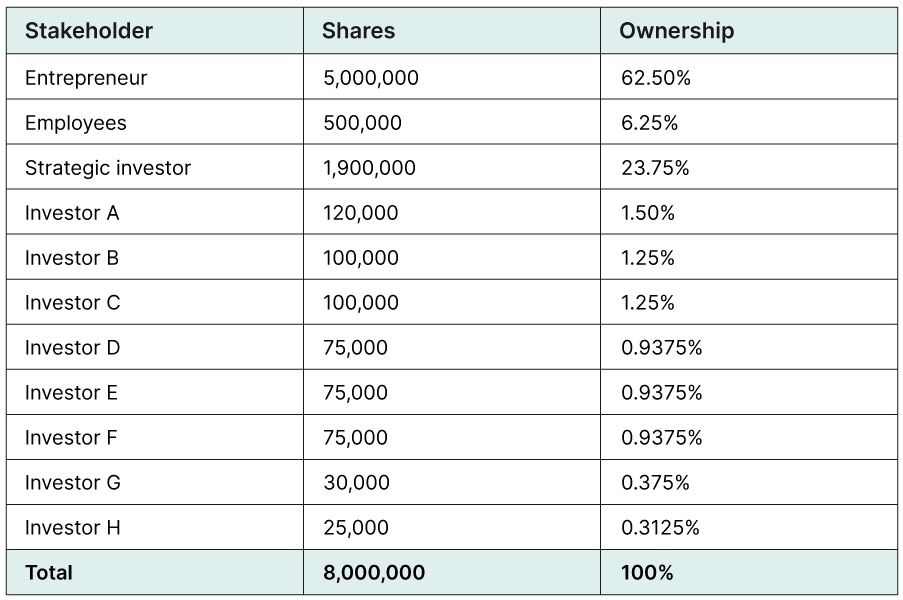
A private company has the following fully‑diluted capitalization, which includes all shares currently issued to shareholders, as well as all potential future shares, like warrants, options, and convertible securities (SAFEs and notes).
Original cap table (11 separate entries)
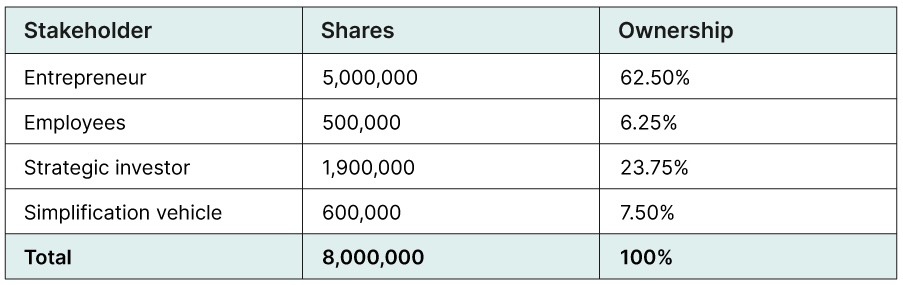
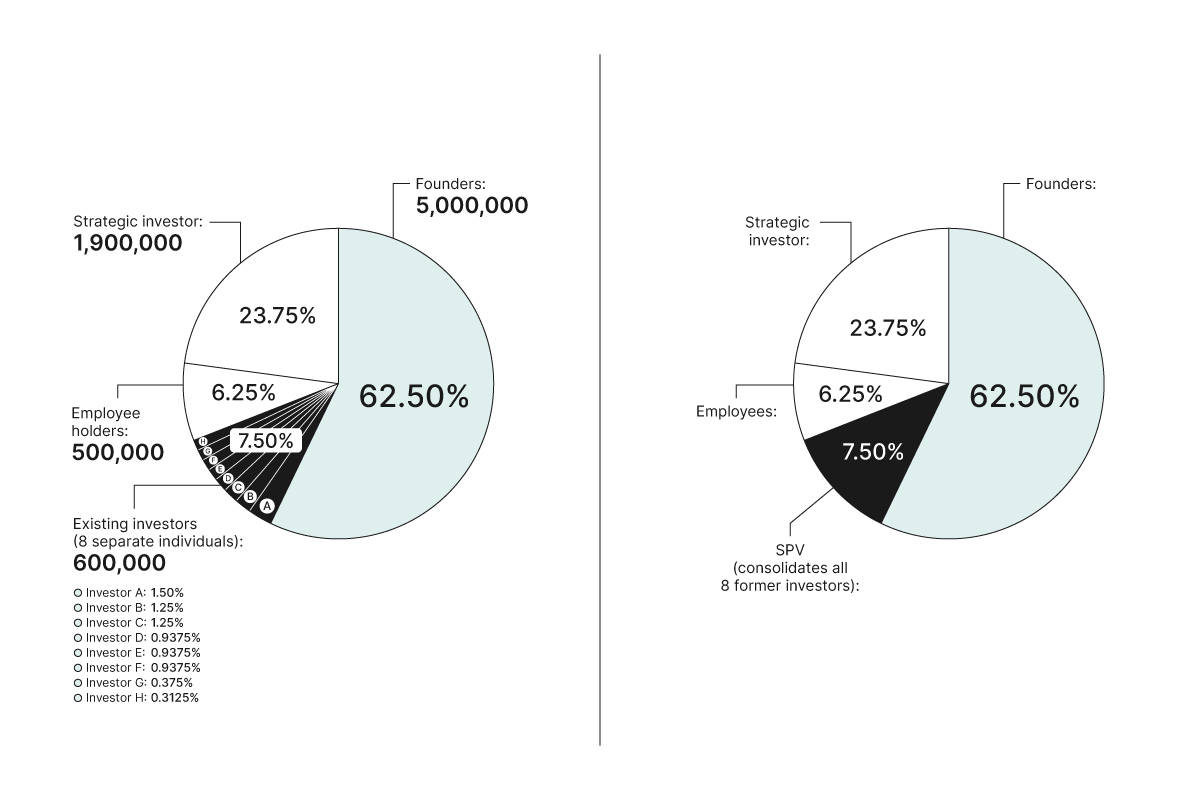
The entrepreneur then consolidates eight investors into a simplification vehicle. Now, the cap table appears as the following:
Post-simplification cap table (4 entries)
How investor returns work inside a simplification vehicle
In the example above, Investor A owns 20% (120,000 shares) of the SPV, and the SPV owns 7.5% of the company. If the company pays a $10M distribution to shareholders, Investor A would receive $150k via the SPV, excluding any fees, which reflects the same return that Investor A would receive directly on the cap table (before any fees).
When simplification vehicles are the most useful
Private companies with the following characteristics can benefit substantially from using a simplification vehicle to consolidate their investors:
- Long tails of small stakeholders
- Frequent corporate actions ahead
- You are expected to make corporate decisions quickly
- Large financing rounds with large institutional investors
- Easier liquidity and transfers
How Zest simplifies the process for you
Zest’s digital infrastructure makes the process of consolidating your stakeholders seamless, handling:
- SPV formation
- Investor KYC and onboarding
- Legal documents and signature flows
- Cap table updates
- Post-close governance tools
With Zest, say goodbye to endless legal hurdles and manual spreadsheets. Our platform is designed to save you time and reduce administrative costs, simplifying the end-to-end transaction process.
Subscribe to the Zest Wire. Insights on private markets.
Biweekly practitioner insights on capital activity, market trends, and conversations shaping MENA and emerging private markets.
From our blog



The private-market platform today’s deal makers demand.