Choosing the right SPV structure in MENA: GP-led vs. joint venture

When you are ready to invest in a private company alongside your network, you will have to decide which type of legal entity should hold your ownership interests. We call these legal entities “Special purpose vehicles”, or SPVs.
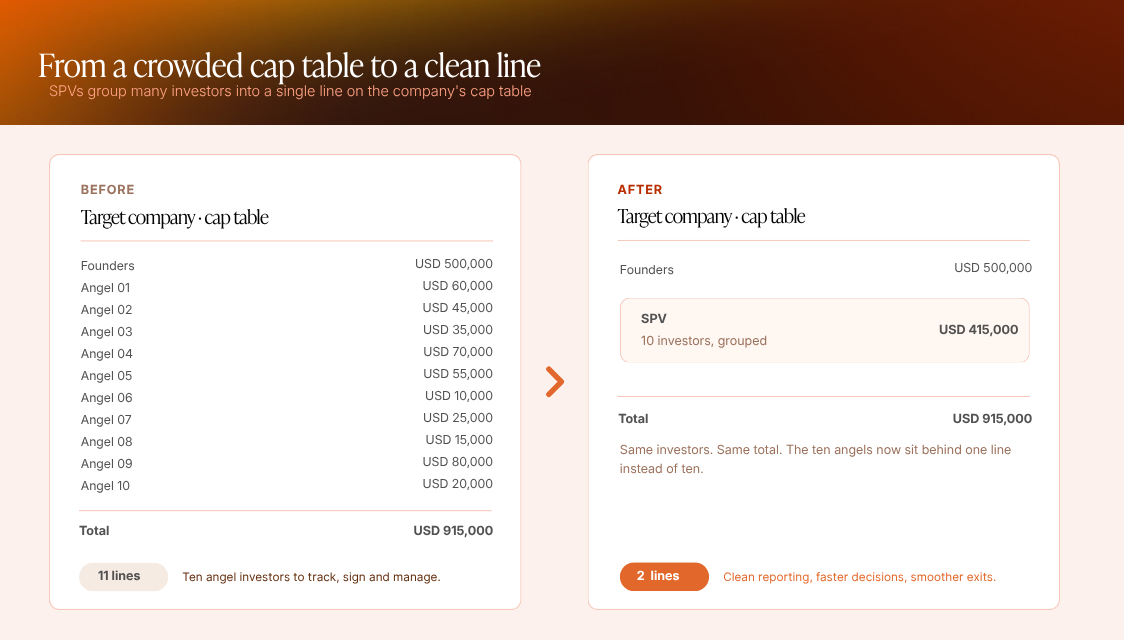
Special purpose vehicles (SPVs) are legal entities designed to group capital from multiple investors into a single investment vehicle for a private-market transaction. While the term “SPV” is a broad term used to describe investors coming together under a single line item on a company’s cap table (or, more generally, the holding structure of any private asset), not all SPVs are structured the same way.
The right SPV structure for your deal depends on several factors, three of which are: how the economics are split, who controls the vehicle’s decisions, and how involved your investors are. Based on these three criteria, deal leads typically choose either a GP-led SPV or a joint-venture SPV.
Key takeaways:
- An SPV groups several investors into a single investment vehicle for a single private market deal, creating a clean line on the company's cap table instead of many (or, more generally, the holding structure of any private asset).
- The right structure comes down to three questions: how the economics are split, who controls decisions, and how active your investors are.
- GP-led SPV: One lead controls the deal; investors stay passive. This is akin to a fund-type structure.
- Joint venture SPV: Co-investors share control and economics.
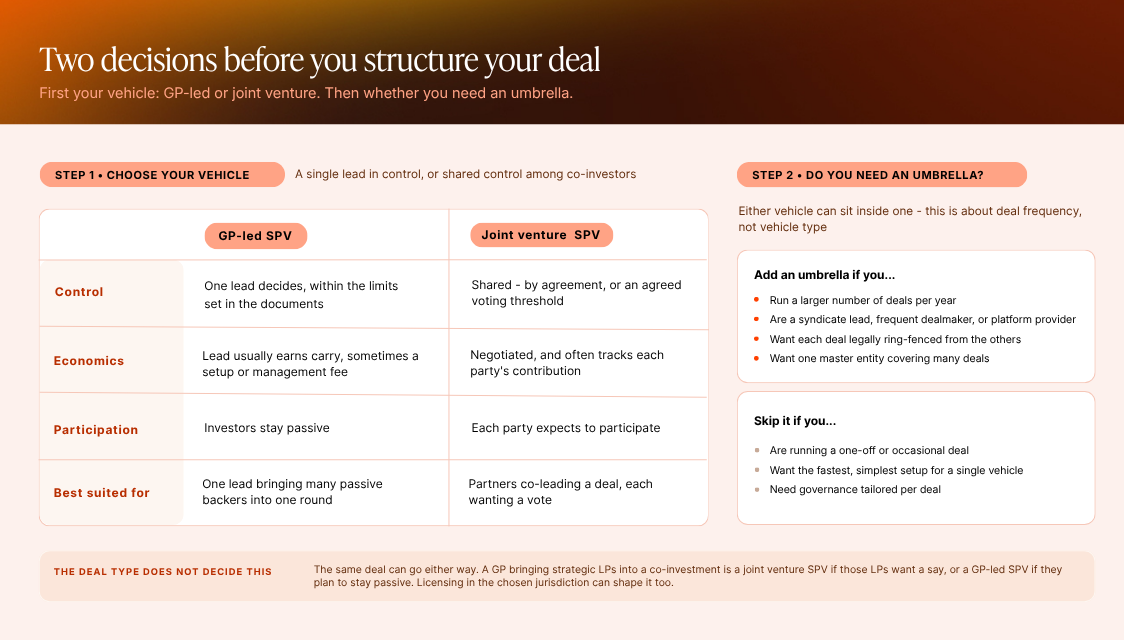
Your SPV structure determines economics, control, and participation
Before choosing a structure for your SPV, consider your arrangement with the other investors in the vehicle. Here is how to think about each of the lenses that will help you make your decision:
- Economics: Who receives the returns, in what proportion, and whether the lead earns a share of the profits (carried interest) or a fee for organizing the deal.
- Control: Who holds decision-making authority over the investment, from signing the deal to deciding when to exit. Which decisions do your investors expect to have a say in, and which decisions will you have authority to make?
- Participation: How active the investors are. In some structures, investors commit capital and stay passive; in others, they are active participants, with voting rights on decisions related to the investment’s economics and direct contact with the underlying company.
The GP-led SPV: one lead, passive investors
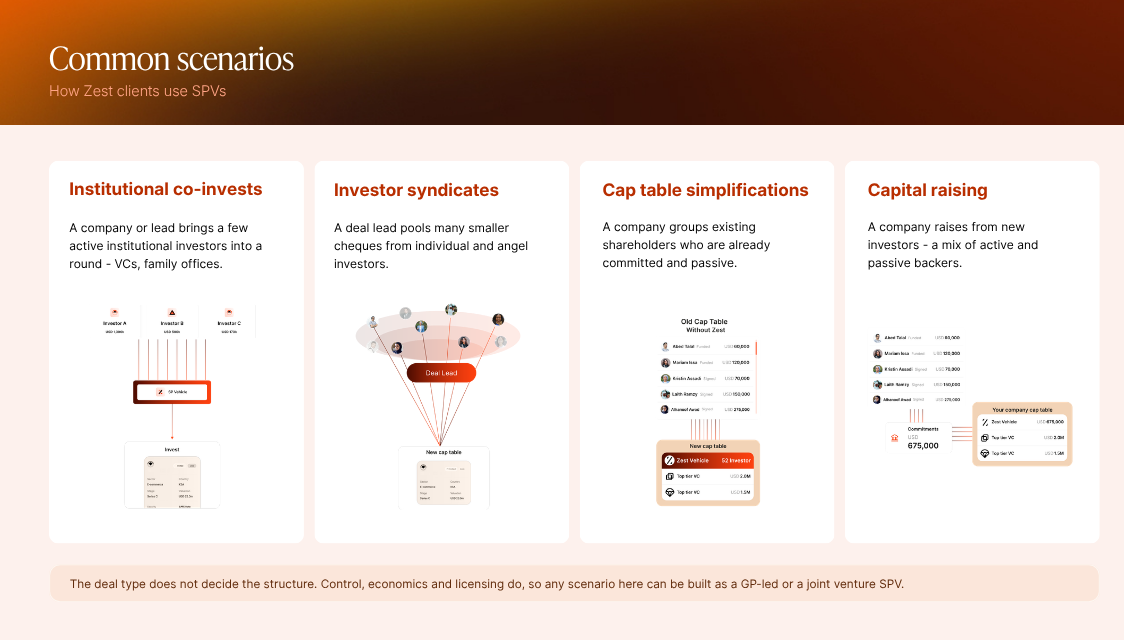
A GP-led SPV is designed for a single, stand-alone deal, where a single deal lead sources the deal, sets the terms, and makes the decisions, much like the general partner of a fund. Investors in this structure remain passive, receive their share of returns, and, for the most part, do not actively participate in vehicle-level or portfolio-company decisions.
Within the limits set out in the vehicle’s documents, the lead can act without obtaining approvals for each step. In exchange, the lead takes on the responsibility that comes with directing other people's capital and usually earns carried interest (i.e., a share of the deal's profits), plus, in some cases, a setup or management fee.
Deal leads most often use this structure to combine multiple smaller, passive backers into a single line on the target's cap table: angel syndicates, friends-and-family rounds, and single-asset deals where one person manages the investment.
What works well:
- Decisions are fast and clean because one person makes them.
- It scales to many passive investors without giving each one a vote.
- The lead earns carry for sourcing and managing the deal.
- Investors get access without taking on management work.
What to watch:
- The lead carries the responsibility and the duties that come with controlling other people's capital.
- Investors give up some control, so the terms have to set expectations clearly.
- Document the lead's authority in the relevant documents to prevent future governance conflicts.
- The lead may require certain licensing or regulatory permissions, depending on the SPV's jurisdiction. A third-party service provider may satisfy regulatory requirements, but could also add costs to the structure.
What to consider before choosing a GP-led SPV: whether this is a one-time deal or you plan to organize other investments in the future, how much authority you need, the carry and fee terms, and which decisions the documents should reserve to you or require investor input on.
The joint venture SPV: shared control among the co-investors
A joint venture SPV shares control among a number of co-investors. No single lead acts alone. Instead, the parties make decisions together or by voting, with consent thresholds agreed in advance. Each party expects to participate in certain matters.
Both the governance structure and economic split reflect a shared partnership. Major decisions require agreement, or they must meet the voting threshold set in the constitutional documents. The parties negotiate economics rather than a single lead setting them, and the split often tracks each party's contribution, with fees and carried interest included only if the parties agree.
Co-investors use this structure when partners want to invest together in a single deal, and each wants a say: investment club deals, co-GP arrangements, and deals where strategic partners invest together and intend to stay involved.
What works well:
- The partners are aligned and engaged, since each has a stake in the decisions.
- The parties share the workload and risk.
- Terms can be tailored to the specific partners involved.
- The vehicle simply acts as a mechanism to execute the agreed-upon investment and does not require a GP to lead decisions.
What to watch:
- Decisions take longer when several parties have to agree.
- Without a clear process, the parties can reach a deadlock.
- More has to be agreed and negotiated up front.
What to weigh before choosing a joint venture SPV: how decisions get made and what happens if the parties deadlock, the voting thresholds, and which decisions are treated as reserved matters that need the parties' consent, the transfer and drag-along and tag-along rights, and what each party is responsible for delivering.
The umbrella structure: one master entity, one portfolio per deal
An umbrella structure uses a single master entity that can quickly set up separate vehicles (called “portfolios” or “cells”) for each new deal under a consistent legal and tax framework. Each portfolio's assets and liabilities are kept legally separate from the others, so what happens in one deal does not affect the investments held in another.
Umbrella structures can be set up using either a GP-led model or a JV model, making it important to understand which model you need.
The main difference between an umbrella structure and a stand-alone GP-led or JV SPV is that the umbrella structure is designed for a syndicate lead or frequent dealmaker(s). This allows the dealmaker(s) to run many deals by establishing a new portfolio under the same master entity each time, rather than forming a brand-new standalone company for each deal. On the infrastructure side, platforms and service providers often use umbrella structures to streamline governance and investment operations, making it easier for dealmakers to stand up new SPVs quickly.
What works well:
- Each new deal is faster and cheaper to set up than a standalone vehicle.
- Deals are separate, so risk in one does not spread to the rest.
- One master entity covers multiple deals, simplifying administration.
What to watch:
- The initial setup for the master entity is more involved than that of a single SPV.
- The master entity needs ongoing administration and oversight.
- While legal separation is embedded in the structure's constitutional documents, depending on the umbrella structure type and jurisdiction, the portfolios or cells may not have an independent legal personality or may require additional custom governance documents.
- An umbrella structure offers less flexibility because the constitutional documents that define governance are set at the master umbrella level and apply across all vehicles (or “portfolios”).
What to weigh before choosing it: how often you do deals (the structure pays off with larger volume), how the master entity will be administered, and how each portfolio's terms get set.
The two models side by side
Compare the key factors that distinguish a GP-led SPV from a joint venture SPV and an umbrella structure.
What deal makers look for when choosing a jurisdiction
If you are arranging a deal in the region, it is fair to ask why an SPV is formed in one jurisdiction rather than another, or offshore rather than onshore. Three practical factors tend to drive that decision.
Investor familiarity
A handful of jurisdictions have become the global standard in private markets. Cross-border LPs - common in MENA deals - recognize the structure, which shortens diligence and removes friction at subscription.
Tax neutrality
Investors generally prefer a tax-neutral vehicle, so tax is handled where each investor and the underlying asset sit, rather than adding a layer in between.
Legal certainty and licensing
A well-tested legal regime gives dealmakers predictability about how the vehicle will behave, providing the consistency and dependability they need when running their investing business. It is also necessary to understand the licensing requirements of a specific jurisdiction to understand whether the dealmaker or their platform provider must hold the required regulatory license to run their deals.
Which legal documents to expect
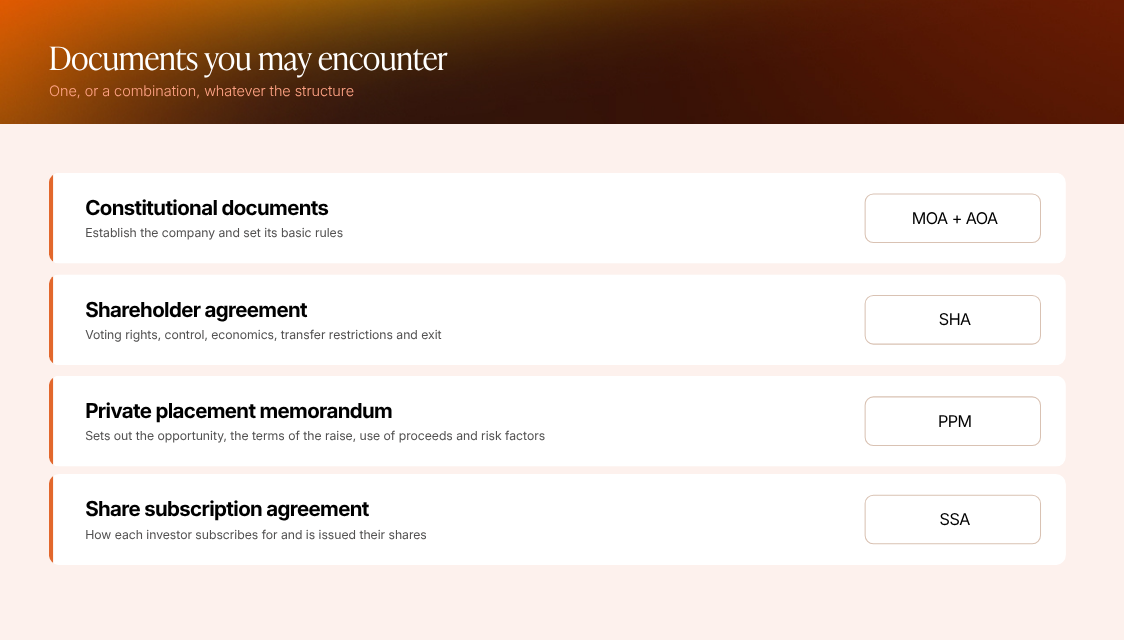
SPVs, regardless of their exact structure, share similar document sets issued to investors. As an investor in an SPV, you will receive one, or a combination, of the following documents:
- Constitutional documents: The Memorandum of Association (MOA) and the Articles of Association (AOA), which establish the company and set its basic rules.
- Shareholder agreement (SHA): In certain jurisdictions, this agreement governs the relationship between shareholders, including voting rights, control, economics, transfer restrictions, and exit.
- Private placement memorandum (PPM): The offering document that sets out the investment opportunity, the terms of the raise, use of proceeds, and risk factors. Investors review it before subscribing. It is more common for larger or multi-asset raises, and for single-deal SPVs.
- Share subscription agreement (SSA): The agreement under which each investor subscribes for and is issued their shares.
While most investors are familiar with a private placement memorandum (PPM), this document is reserved for traditional multi-asset funds, rather than SPVs.
Running your deal on modern infrastructure
Setting up any of these structures has traditionally meant lawyers drafting documents from scratch, redlines going back and forth, paper signatures, and weeks of turnaround before a deal could close.
How Zest can help
Zest is a digital transactional infrastructure company powering private-market transactions. Zest offers a layer of digital execution capabilities for SPV formation and deal workflow management, plus FSRA-regulated escrow and arranging services, that together simplify, safeguard, and scale private-market transactions on one digital platform. To date, we have digitized US$305M+ across 228+ transactions for 2,000+ investors, with around 63% of deal makers returning for their next deal.
Ready to structure your next deal?
Head to our contact us page, tell us about your transaction, and we will respond within 24 hours.
Frequently asked questions
Can I make decisions on behalf of my investors?
Yes, in a GP-led SPV model, within the limits of the constitutional documents. In a joint venture SPV, the parties share certain decisions in accordance with the voting thresholds set in the agreed governing documents.
Where are SPVs formed on Zest?
Entities on Zest are formed in the Cayman Islands. Under the umbrella structure, the master entity is formed as a Segregated Portfolio Company, while each individual entity is called a Segregated Portfolio. Cayman is a global standard jurisdiction in private markets, recognized by cross-border LPs and tax-neutral at the vehicle level.
Which document defines who controls the SPV?
Typically, the constitutional documents set voting rights, reserved matters, economics, transfer restrictions, and exit terms.
Do I need a PPM for an SPV?
Not necessarily. A private placement memorandum is more common in traditional multi-asset funds, U.S.-domiciled SPVs, and sometimes GP-led SPVs.
How many investors can an SPV hold?
Both GP-led and JV structures can scale to many investors, depending on how the vehicle’s governance is designed in its constitutional docs.
Subscribe to the Zest Wire. Insights on private markets.
Biweekly practitioner insights on capital activity, market trends, and conversations shaping MENA and emerging private markets.
From our blog


منصة الأسواق الخاصة التي يطالب بها صانعو الصفقات اليوم.